There’s something wonderfully simple about taking your dog for a walk. Grab the lead, put your shoes on and head out the door, right?
Until you get halfway down the road and realise you forgot the poo bags. Or you arrive at the park and discover you’ve brought the water bottle but not the bowl. Or you’ve planned a lovely muddy countryside walk but forgotten the towel.
Having the right dog walking essentials ready to go can make your walks much easier, whether you’re heading out for a quick 20-minute stroll around the neighbourhood or spending a few hours exploring the countryside.

The good news is that you really don’t need to take half the house with you. A few reliable basics will cover most walks, with a handful of extra dog walking accessories worth adding depending on the weather, your route and your dog’s needs.
In this guide, I’m sharing the dog walking essentials I think are worth having, what you might want to add for longer or more adventurous walks, and how to build a dog walking kit that works for you.
If you are a new dog owner, check out my full Dog Essentials Checklist for everything you need for your new companion.
Quick dog walking essentials checklist
If you’re looking for the short version, these are the things I would consider the basics:
- A collar and/or harness
- A secure dog lead
- ID tag
- Poo bags
- Treats
- A dog walking bag or somewhere to carry your essentials
- Water and a portable bowl for longer or warmer walks
- A towel for muddy or wet dogs
- Weather-appropriate clothing or equipment
- A torch or reflective/light-up accessory for darker walks
You won’t necessarily need every item on every walk. A quick walk around the block in the middle of summer is very different from a two-hour countryside adventure in January.
Let’s take a closer look at what is actually worth packing.
1. A dog collar or harness
First up is the obvious one: something your dog can safely wear while you’re out walking.
Whether you prefer a collar, harness or both will depend on your dog and what works best for you. The important thing is that whatever you’re using fits correctly, is comfortable and is in good condition.
It’s also worth regularly checking your dog’s walking equipment for signs of wear. Clips, buckles and stitching can all deteriorate over time, particularly if you’re regularly walking in wet or muddy conditions.
Collars
A collar is also important for carrying your dog’s ID tag.
My dog has lost her ID tag multiple times on a big off lead walk. So to avoid them getting caught and ripped off in bushes or woodland, I now use a personalised dog collar. This has our details directly on the collar, so no dangling ID tag necessary.
I’ve also in the past loved having a waterproof dog collar. This rubber collar was so easy to wipe clean, which is necessary if your dog loves rolling in smelly things.
Harnesses
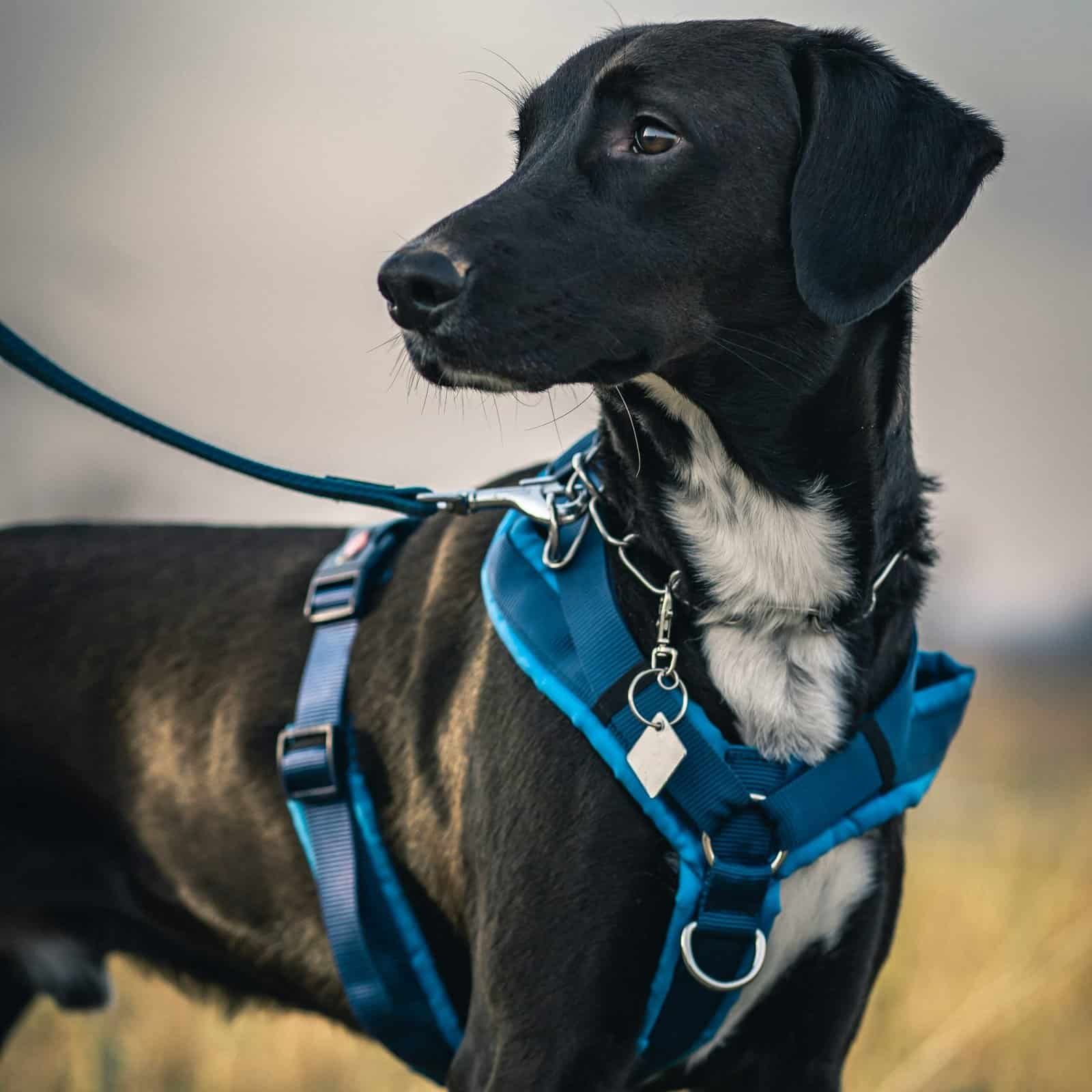
Many people love to use a harness to attach the dog’s lead to. Harnesses can help control dogs who pull strongly and avoid too much pressure on the dog’s neck. Not to mention a harness can be a stylish accessory too.
If you’re looking for a harness for a strong dog, my favourite harness is the Halti No-Pull Harness – you can read my full review here. For a dog that pulls strongly like mine, it really helps me feel comfortable and in control.
Harnesses are also important if you travel with your dog in the car, to attach a dog seat belt too. Read up on safe car travel for dogs here.

2. A reliable dog lead
Your everyday lead should be comfortable for you to hold, secure enough for your dog and appropriate for the places you normally walk.
For everyday walks, a standard lead is likely to be all you need. If you’re working on recall or giving your dog more freedom in suitable areas, a long line can also be incredibly useful.
Whatever type of lead you use, give it a quick check from time to time. If you spot fraying, damaged clips or worn stitching, it’s time for a replacement.
I have multiple leads for different occasions. I love the Halti training lead, which is double ended so you can clip it to the front of a harness. I use a figure of 8 lead to have maximum control of my dog when walking with my baby in the pram around our town. Finally I have an extendable lead for more adventurous walks.
If you’re a runner, I would highly recommend a hands-free dog lead.
3. Poo bags
I don’t think I need to explain this one.
Poo bags are perhaps the least glamorous but most essential item on this list. And my advice is simple: take more than you think you’ll need.
Keep some in your dog walking bag and consider keeping a spare roll somewhere easy to grab, too. I always keep some in my car. There is nothing worse than discovering you’ve used your last bag and your dog decides that now is the perfect time to go.
A small poo bag holder that clips onto your lead or walking bag can also make them much easier to access.
4. Your dog’s ID tag

Your dog should have an appropriate ID tag attached to their collar when you’re out in public.
It’s one of those things that is easy to take for granted, but it’s worth checking regularly that the tag is still securely attached and that the details are readable. Don’t forget to update your dog’s details if your contact information changes.
Not sure where to get an ID tag from? It couldn’t be easier these days – you can order then online from many websites including Amazon or Etsy. If you want to pick one up in person, try a key cutting shop like Timpsons, or a pet shop.
5. Treats
Treats aren’t essential for every single dog walk, but I personally think they’re one of the most useful things to have with you.
They can be handy for:
- Practising recall
- Rewarding good behaviour
- Redirecting your dog’s attention
- Training around distractions
- Making new experiences more positive
- Emergency bribery when your dog has discovered something far more interesting than you
A small treat pouch makes life much easier than carrying a handful of treats around in your pocket.
If you’re working on training, particularly recall, having some high-value treats available can be especially useful.
6. A dog walking bag
A dedicated dog walking bag is one of my favourite ways to keep everything together. Especially in the warmer dryer months when I’m not wearing a coat, I don’t always have pockets to keep things in.
You can use it for poo bags, treats, your phone, keys, hand sanitiser and all those little extras you seem to accumulate whenever you leave the house with a dog.
I’ve been using the Cocopup Dog Walking Bag and it’s become one of those things I wouldn’t really want to walk without.
Look for something that is comfortable to wear and has enough compartments for the things you actually carry. You don’t need a giant backpack for a 20-minute walk!

7. Water and a portable bowl
For a short walk on a cool day, you may not need to carry water with you. But once the weather warms up or you’re going on a longer walk, it’s definitely worth having some with you.
A portable water bottle and collapsible bowl are great to have. They’re handy for days out, long road trips, and dog-friendly holidays, so they’re one of those purchases that can get much more use than you might initially expect.
8. A towel
If you have a dog who enjoys finding every single muddy puddle, a towel is absolutely one of your dog walking essentials.
I like keeping an old towel in the car as well as having one at home, because you never know when a perfectly innocent walk is going to turn into a full-body mud experience.
You don’t need anything fancy. An old towel can do the job perfectly well.
9. Weather-appropriate dog clothing
The British weather means your dog walking kit might look completely different in January compared with July.
Some dogs may benefit from a coat in cold or wet weather, particularly if they have a thin coat or struggle to stay warm. Other dogs are perfectly happy without one.
The important thing is to consider your individual dog, rather than assuming every dog needs the same equipment.
For wet weather, a lightweight waterproof coat can be useful. For winter walks, reflective or high-visibility clothing can also help you and your dog stay more visible when the days are short.
10. A favourite toy or ball
Does your dog love playing fetch? Then their favourite toy might deserve a place in your dog walking bag.
A ball can provide extra enrichment during a walk and can be a useful way to add play into your dog’s routine.
That said, you don’t necessarily need to carry a toy on every walk. For some dogs, sniffing, exploring and interacting with their environment is more than enough enrichment.
11. Something reflective for darker walks
During the shorter days of autumn and winter, you may find yourself walking in the dark more often. A reflective collar, harness, lead or coat can make your dog easier to see, while a light-up accessory can be useful too.
I have a small ball shaped charm that clips onto my dog’s collar and has a flashing light. Easy peasy, cheap, and small enough to fit in the dog walking bag too so I don’t forget it.
Don’t forget about yourself. A torch or head torch can make a huge difference when you’re walking somewhere without good street lighting.
If you’re heading out in the dark, stick to routes you’re familiar with and take sensible precautions for both you and your dog.
Dog walking essentials for different types of walk
One of the easiest ways to work out what you actually need is to think about the type of walk you’re going on.
For a quick everyday walk
You can keep things very simple:
- Collar/harness
- Lead
- ID tag
- Poo bags
- A few treats
That’s probably enough for most quick walks around your local area.
For a long countryside walk
For a longer adventure, I’d add:
- Water
- Portable bowl
- Treats
- Long line lead
- Towel
- Phone
- Weather-appropriate clothing
- Torch if you’re likely to be out late
This is where having a dedicated dog walking bag really comes into its own.
For a summer walk
In warm weather, think about:
- Plenty of water
- Portable bowl
- Dog walking bag
- Poo bags
- Treats
- Cooling equipment if appropriate
- Lightweight lead/harness
It’s also important to consider the temperature and timing of your walk rather than relying on equipment alone.
If the weather is particularly hot, changing your walking routine may be much more important than adding another product to your bag.
What should you keep in your dog walking bag?
If you want to avoid the daily scramble of wondering where you’ve put everything, I recommend creating a little permanent dog walking kit.
Mine would include:
- Poo bags
- Treats
- Treat pouch
- Spare lead
- Collapsible water bowl
- Dog towel
- Torch
- Hand sanitiser
Then you only need to add anything specific to that day’s walk.
This is particularly useful if you’re someone who is always running out the door at the last minute. A permanently packed walking bag means you can grab it and go.
Dog walking accessories you don’t necessarily need
The pet industry is very good at convincing us that our dogs need approximately 47 different accessories for a walk. They don’t.
There are some lovely dog walking products available, and I absolutely enjoy trying them, but the best dog walking kit is the one that makes your life easier.
Start with the basics and add things as you discover what would genuinely make your walks easier. For example, I like to keep tissues in my bag to wipe my glasses if it rains, or to wipe my dog’s drool off her face.
How to create your own dog walking essentials checklist
Rather than copying someone else’s perfect dog walking kit, think about your own routine.
Ask yourself:
Where do I normally walk?
Town walks, parks, beaches and countryside trails all have slightly different requirements.
How long are our walks?
A 20-minute local walk doesn’t require the same kit as a three-hour hike.
What is my dog like?
A dog who loves swimming will probably require a towel. A dog who is still learning recall might benefit from a long line. A dog who eats everything they find may require a very different walking strategy!
What is the weather like?
The UK’s weather can change dramatically throughout the year, so your walking bag will probably need a seasonal refresh.
What do I actually use?
This is the most important question.
If something has lived in your walking bag for six months and you’ve never used it, perhaps you don’t need to carry it around every day.
Final thoughts on dog walking essentials
You don’t need a suitcase full of equipment to enjoy a good walk with your dog.
The most important things are the basics: a secure way to walk your dog, identification, poo bags and whatever you need to keep them comfortable and safe. Everything else depends on your dog, your walking routine and the conditions outside.
Once you’ve found a few dog walking essentials that work for you, keeping them together in a dedicated walking bag makes getting out of the door much easier.
Frequently asked questions about dog walking essentials
What are the essential things to take on a dog walk?
The basic dog walking essentials are a secure collar or harness, a lead, ID tag and poo bags. Depending on the length and conditions of your walk, you may also want to take treats, water, a portable bowl and a towel.
What should I keep in my dog walking bag?
A useful dog walking bag could contain poo bags, treats, a spare lead, a portable water bowl, towel and other items you regularly need. You can then add seasonal items such as a coat or reflective accessories when necessary.
What dog walking accessories do I actually need?
You don’t need every dog walking accessory available! Start with the basics and add things that genuinely make your walks easier. A walking bag, treat pouch, portable bowl, long line and reflective gear can all be useful depending on your routine.
Do I need to take water on every dog walk?
Not necessarily. For a short walk in cool weather, your dog may not need you to carry water. For longer walks or warm weather, however, taking fresh water and a portable bowl is a sensible idea.
What should I take on a long dog walk?
For a longer dog walk, consider taking water, a portable bowl, poo bags, treats, a phone, towel, long line, weather-appropriate clothing and basic first aid supplies. A torch and tick remover can also be useful for countryside walks.
What should I take on a dog walk in winter?
Winter dog walking essentials might include a towel, waterproof coat if your dog needs one, reflective equipment, a torch and spare lead. Don’t forget to think about your own clothing and footwear too!
Recommended Posts For You
Here are some other blog posts you will love.